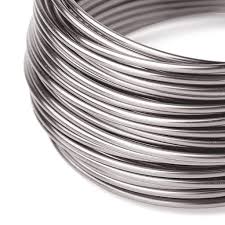
Essential CHQ Wire Guide
Key Manufacturing Processes:
- HRPPD (Heat-Resistant Pre-Phosphate Drawing)
- SAPPD (Spheroidized Annealed Pre-Phosphate Drawing)
- DAPPD (Double Annealed Pre-Phosphate Drawing)
| Element | Percentage Range |
|---|---|
| Carbon (C) | 0.2% – 1.0% |
| Manganese (Mn) | 0.5% – 2.0% |
| Silicon (Si) | 0.3% – 0.8% |
| Chromium (Cr) | 0.05% – 0.15% |
| Nickel (Ni) | 0.1% – 0.4% |
| Copper (Cu) | 0.001% – 0.03% |
| Iron (Fe) | Balance |
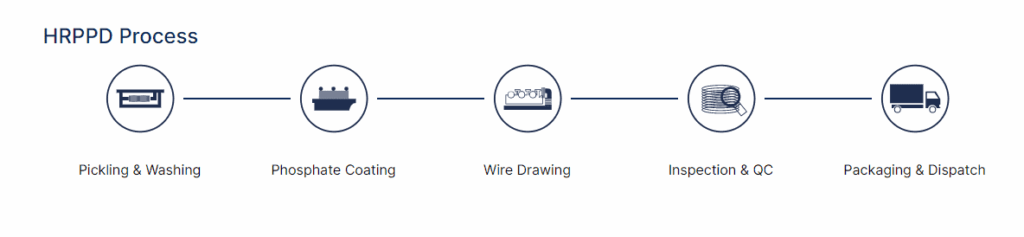
The HRPPD process is the most common method and involves five stages: pickling and washing, phosphate coating, wire drawing, inspection and QC, and packaging and dispatch. The key difference between HRPPD and other processes is that the wire does not undergo spheroidized annealing.
Phosphate coating is applied during the phosphate coating stage. This layer of coating helps to protect the wire from corrosion and extends its life. The wire is then drawn through a series of dies to reduce its diameter.
Inspection and QC are carried out during the inspection and QC stage to ensure the wire meets the required standards. The wire is then packaged and dispatched for use.
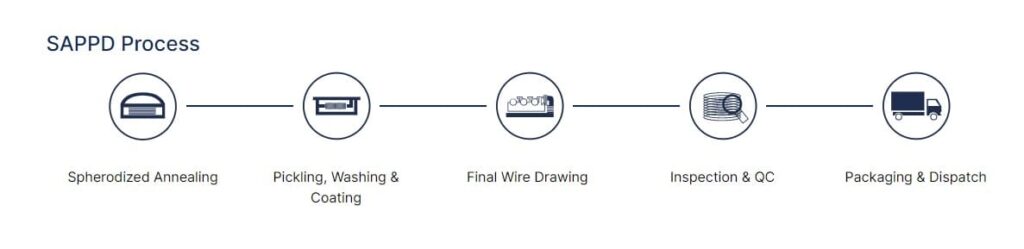
Under the SAPPD process, wire under spheroidized annealing. This process eliminates decarburization and provides improved tolerances when cold drawing from appropriate input sizes. It also helps to avoid ovality by providing tighter tolerances in drawing from proper input sizes and uniform grain size.
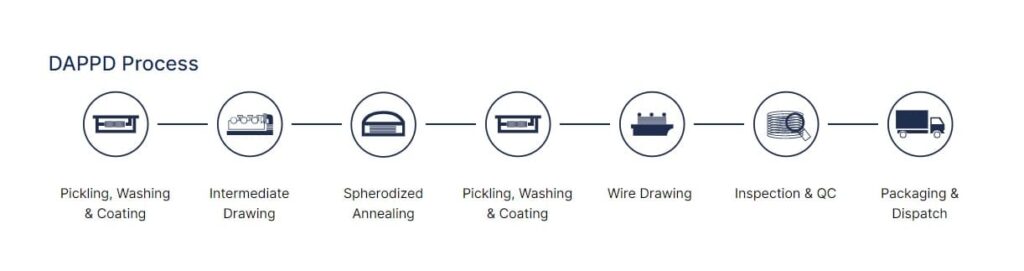
The DAPPD process is similar to the SAPPD process. However, the wire is pickled, washed, and coated twice. It also goes through an intermediate drawing procedure before being spherodized annealed. Nitrogen atmosphere is preferred at this stage.
What are the main benefits of CHQ Wires?
- Improved tolerances when drawing from appropriate input sizes
- Eliminates decarburization
- Provides tighter tolerances in drawing from proper input sizes
- Reduced ovality by providing tighter tolerances in drawing from proper input sizes
- Higher strength-to-weight ratio than other types of steel wire
- Enhanced Fatigue Strength
- CHQ wires have higher yield strengths compared with conventional grades of steel wire. These high yield strengths make them more resistant to fatigue damage. In addition, they exhibit superior fatigue resistance compared with other types of steel wire.
| Grade | Standard | Min. Tensile Strength |
|---|---|---|
| Grade 1 | ASTM A53/A543 | ≥ 895 MPa |
| Grade 2 | ASTM A53/C591 | ≥ 930 MPa |
| Parameter | Description |
|---|---|
| Yield Strength (YS) | Maximum stress before permanent deformation |
| Ultimate Tensile Strength (UTS) | Maximum stress before fracture |
| Fatigue Life | Average number of cycles before failure under repeated loading |
Main Cold Heading Applications
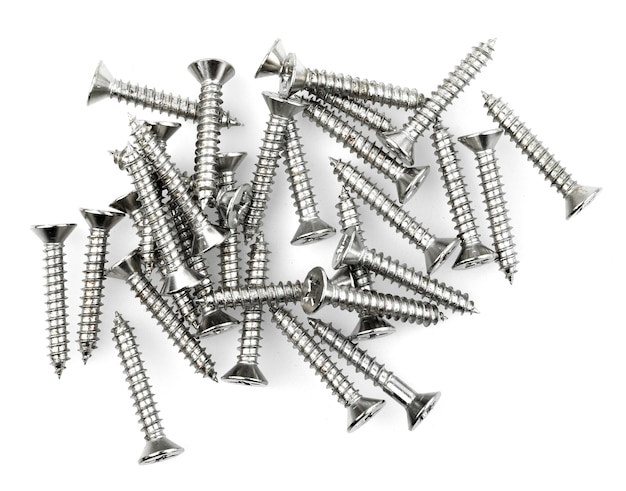
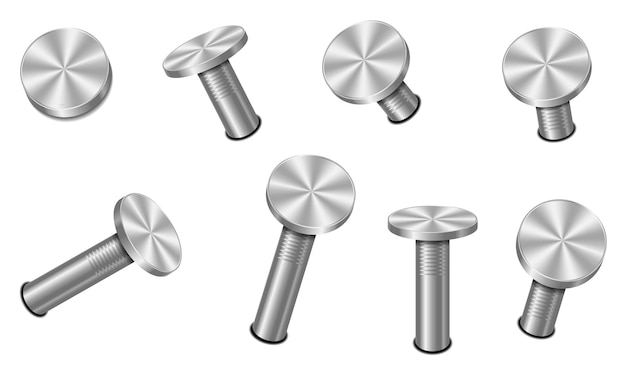
- Fasteners: Widely used in screws, bolts, nuts, nails, and rivets due to excellent formability.
- Automotive Industry: Essential for manufacturing engine parts, suspension components, and transmission parts.
- Aerospace Sector: Preferred for lightweight, high-strength components requiring fatigue resistance.
- Medical Devices: Used in surgical and orthopedic implants for precision and durability.
- Construction Hardware: Ideal for structural joints, brackets, and fasteners in building applications.
- Industrial Machinery: Utilized in bearings, shafts, and various cold-forged mechanical parts.
- Electrical Components: Suitable for terminal pins and connectors that need high conductivity and precision.
- Consumer Goods: Found in items like tools, kitchen appliances, and furniture fittings.
- Surface Quality Matters: High tensile strength and smooth finish are critical for longevity in demanding conditions.
- Cost-Effective Manufacturing: Enables mass production of precise components at lower operational cost.
CHQ wires finds its usage in various industries like Automotive Industry, Engineering Industries, Appliances & Cold forging and fastener applications (like wire for nut bolts).
In general, thread cutting or hot working has been used to create fasteners. However, using the cold working technique to increase production and keep costs low is increasingly popular in fastener uses.
The benefits of this method include excellent surface finish and dimensional accuracy in fasteners. In regions with dissimilar deformation ratios, the cold heading procedure produces significant hardness divergences.
As a result, to minimize scattering of the fastener qualities, an appropriate balance & mechanical characteristics of the raw material must be maintained.

CHQ wires are widely used in the automotive industry for cold forged parts. This includes engine components, transmission components, suspension components, and interior components. These parts require high-quality materials that provide good surface finish and dimensional accuracy. They should also have sufficient strength to withstand severe operating conditions.
These parts are subjected to extreme temperatures during operation, so the properties of the steel need to remain stable over long periods of time. CHQ wires are ideal for use in these types of applications because they are strong, durable, and easy to work.
Another common application for CHQ wire is in armature shafts. Armature shafts are an important component of electric motors and generators, and they need to be able to withstand significant amounts of torque.
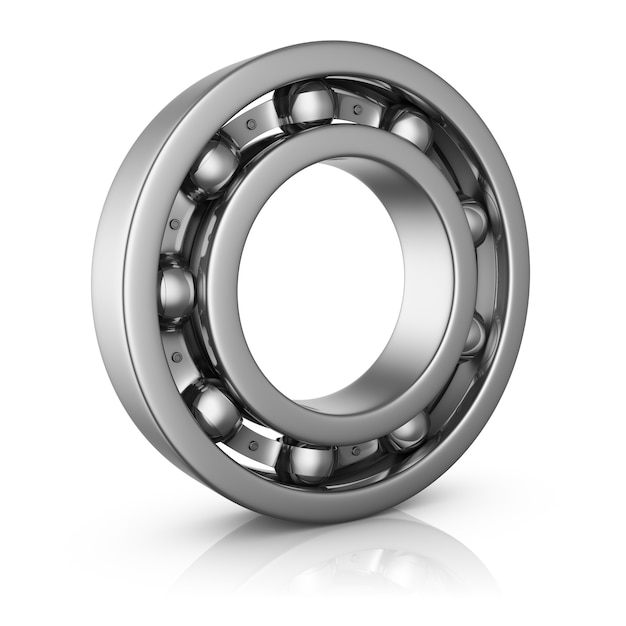
CHQ wire is also used in ball and roller bearings. Ball and roller bearings are essential for transmitting power and motion in a wide range of industrial applications, and they need to be able to withstand significant amounts of torque.
Â
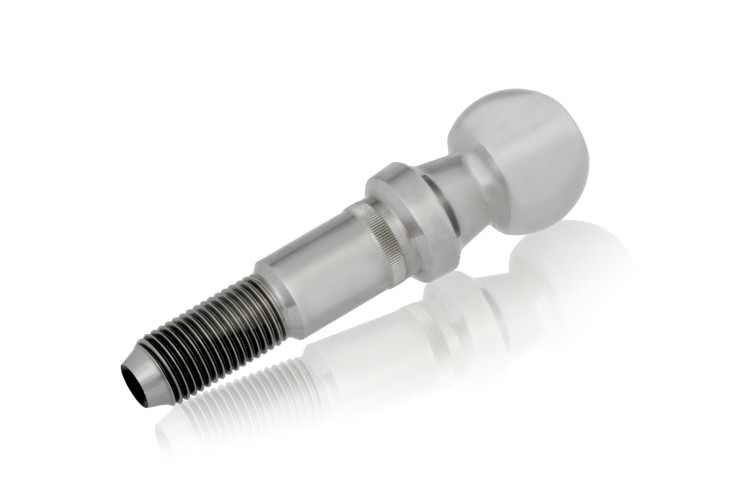
Ball joint studs are commonly made from cold heading quality wire. They are used to join two metal parts together and are available in a variety of sizes and styles. They are a popular choice for use in automotive and engineering applications.
The connecting components between the engine block, cylinder head gasket, and cylinder head are called the Cylinder Head Bolt. It’s mostly composed of Stainless Steel and Carbon Steel. The head bolt is usually a hexagonal shape, and it screws into the engine block.
Â